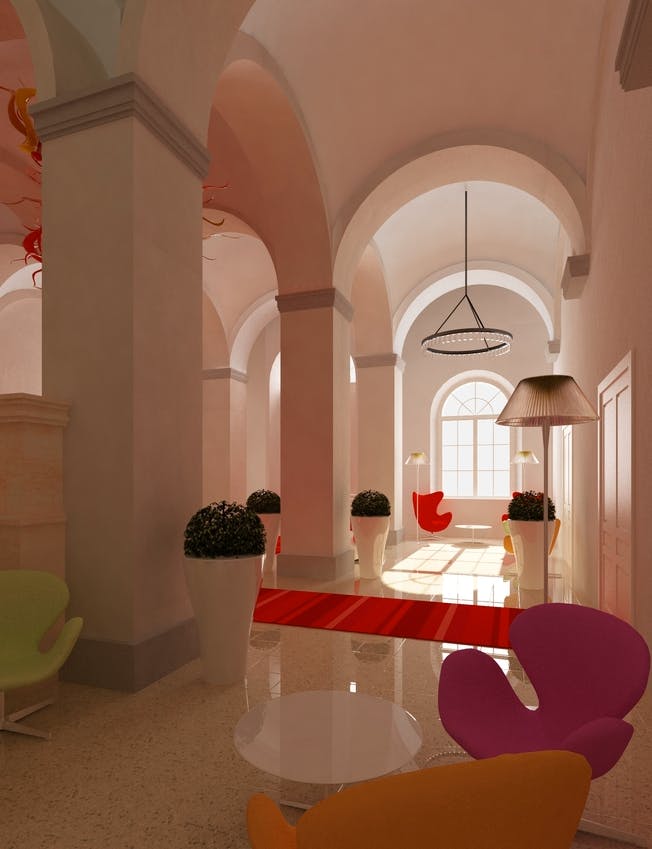
This is a design proposal for the new Pacchiosi Hotel in Parma, meticulously conceived to embody a pleasant and intentional contrast between the venerable forms of a historic building and sophisticated contemporary furnishings. Our approach to designing within a historic context deliberately moves beyond mere integration. We believe that while acknowledging the building's rich past is essential, true contemporary design requires a critical distance, much like the philosophy articulated by Wittgenstein: history is the foundational ground we traverse daily, but once its origins are understood, it's beneficial to set it aside to create for the present—to "throw away the ladder after climbing it." This doesn't negate history's importance; rather, it allows us to build upon it, ensuring our presence is distinct and visible, contributing a new layer to the building's ongoing narrative.
The paramount goal for the hotel's rooms is to achieve a state of total relaxation for every guest. In stark contrast to our ancestors, for whom stress was primarily a survival mechanism against the immediate threat of predators, modern stress is intricately linked to the relentless wear and tear of contemporary life. This includes not only physical threats but also the pervasive pressures of work, complex interpersonal relationships, and financial anxieties. The challenge is that, even after a perceived threat has passed, our bodies often remain in a state of heightened alert and constant anxiety.
Therefore, understanding relaxation at a scientific level became crucial to our design. Physiological relaxation, as confirmed by scientific research, consistently involves:
Decreased respiratory rate and regulated respiratory cycles.
Reduced oxygen consumption.
Increased skin resistance.
Decreased heart rate.
Decreased skeletal muscle tone.
An increase in the level of Alpha brain waves, indicative of a calm, awake state.
The physiological characteristics of the relaxation response fundamentally involve an overall decrease in the intensity of excitation of the sympathetic component of the autonomic nervous system, coupled with a corresponding increase in the activity of the parasympathetic component. This delicate balance manifests through:
Variations in autonomic functions: This includes a decrease in blood pressure and heart rate, reduction of pupillary diameter, decreased sweating, and an increase in the motor and secretory activity of the gastro-intestinal system, all signaling a shift towards rest and digest.
Central nervous variations: These are observed as increased EEG timings (slower brainwave patterns) and skeletal muscle hypotonia (reduced muscle tension), alongside profound changes in the behavior of experience and consciousness, leading to a sense of calm and mental clarity.
Our design choices for the Pacchiosi Hotel—from material selection and lighting schemes to spatial organization and acoustic considerations—are all meticulously calibrated to induce these precise physiological and psychological states of relaxation. This comprehensive approach was developed in collaboration with our valued partners, Gianluca Signaroldi and Andrea Treu, ensuring that every element contributes to an environment of profound tranquility.
Hotel Parma